
Verified hours, ready to upload to iPayroll
Clockie writes your approved timesheets in iPayroll’s own Spreadsheet Format — ordinary time, overtime elements, leave and cost centres in the columns iPayroll expects. Upload the file, check the totals, run the pay.

iPayroll
Receives a timesheet file already shaped to its import spec.
- Export format
- iPayroll Spreadsheet Format (.csv)
- Employee matching
- iPayroll employee ID
- Pay elements
- One column per element, T1 by default
- Leave and costing
- Leave and cost-centre columns included
How it works
From clock-in to pay run in four steps — the hours do the walking.
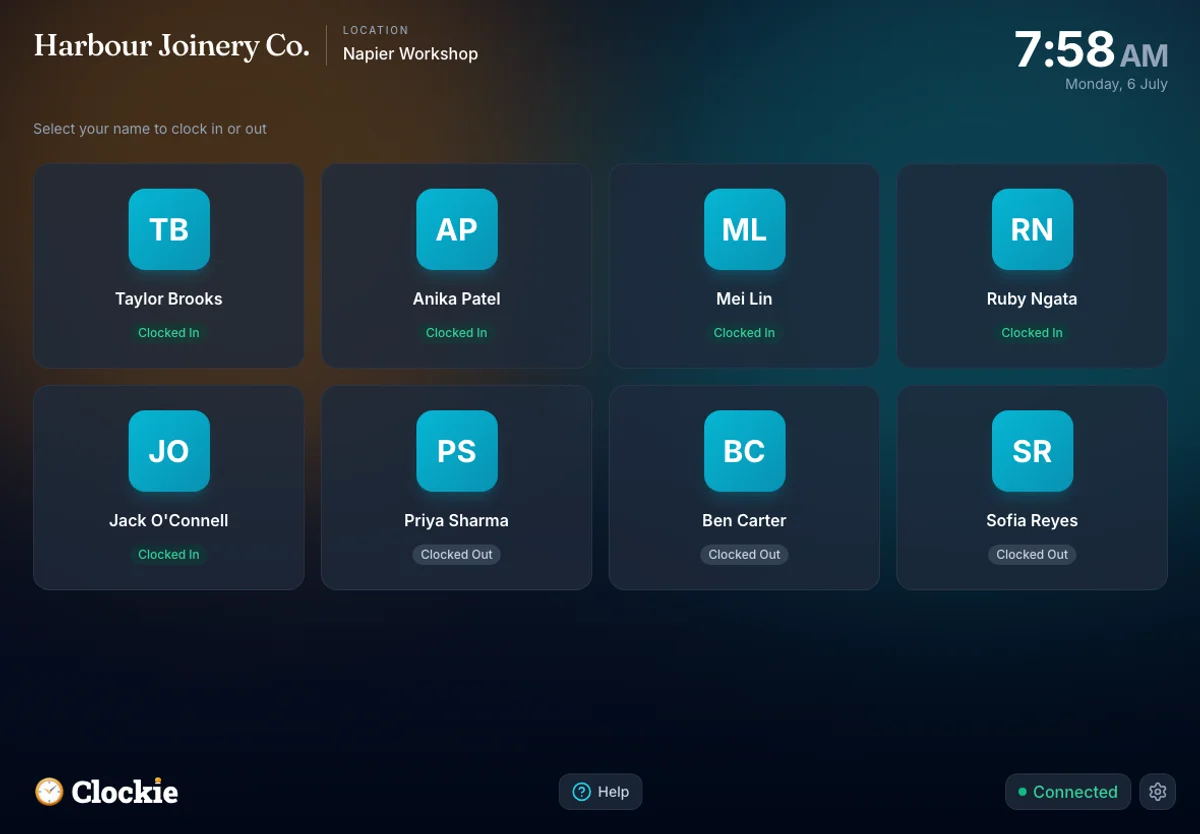
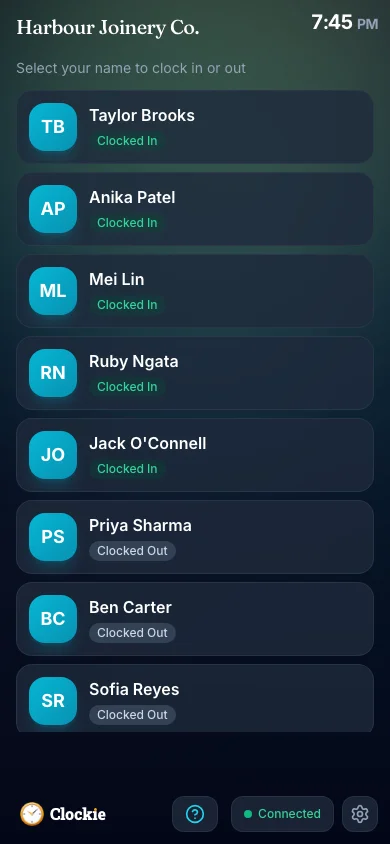
Staff clock in
Your team clocks in and out on a shared tablet or their own phone, verified by PIN, photo or face, or tap-and-go with an optional badge or QR in place of PIN and face checks. Entries queue on the device when the connection drops and sync when it returns.
You approve the pay period
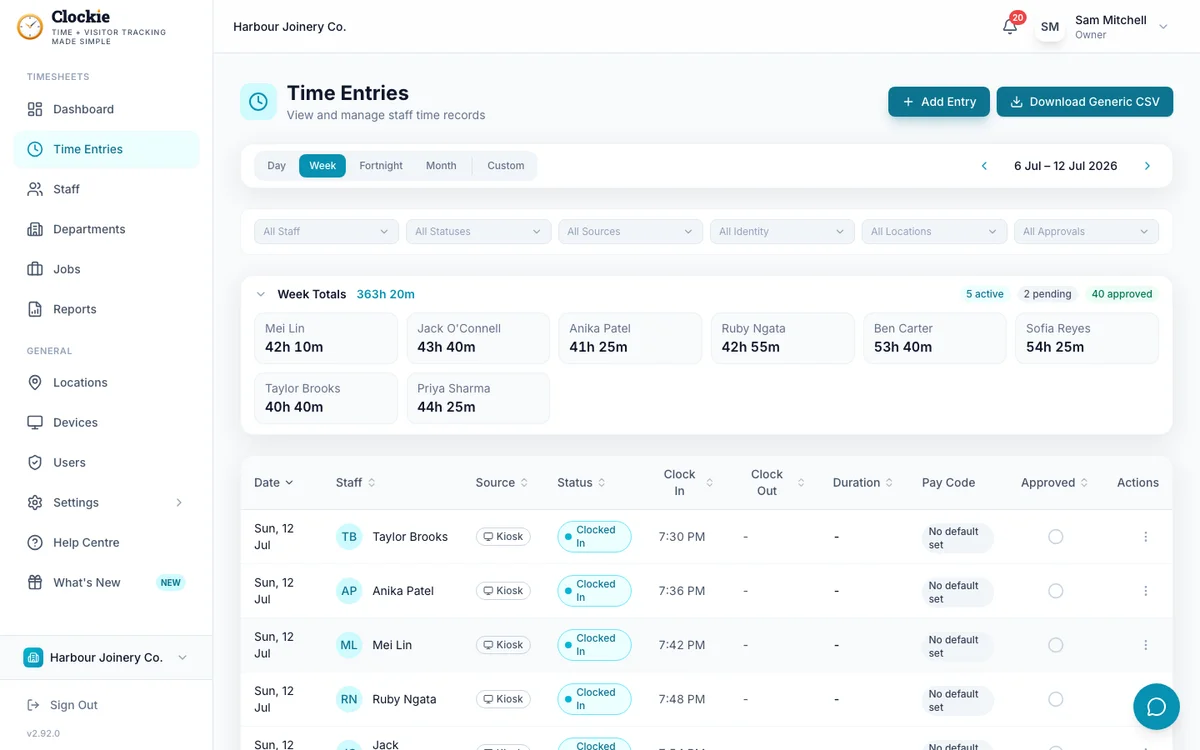
Review the period with break deductions and rounding already applied. Only approved, clocked-out entries can reach the export file.
Build the iPayroll file
Clockie pivots each pay code into its own element column, splits leave onto the documented leave columns, and counts days in period per employee.
Upload in iPayroll
Load the file through iPayroll’s timesheet upload, review the imported values against the open pay, and process the pay as usual.
How the hours reach iPayroll
Approved hours in Clockie
Verified clock-ins with breaks, rounding and pay codes already applied.
Timesheet file
.csv
iPayroll pay run
Receives a timesheet file already shaped to its import spec.
Clockie writes the file to iPayroll's own import spec, so the upload is the whole job — no reshaping columns in a spreadsheet first.
What the iPayroll export covers
Built to the Spreadsheet Format described in iPayroll’s developer upload documentation. Here is exactly what Clockie writes, and what it checks before you download.
- File type
- Comma-delimited .csv with a header row, one row per employee and cost centre, named ipayroll-timesheets-<date>.csv.
- Base columns
- id and name identify the employee; a minimal id, name, T1 file is written when no other elements, leave or cost centres are present.
- Employee matching
- The id column carries each person’s Employee Payroll ID from Clockie, which must equal their iPayroll employee ID.
- Pay elements
- Every Clockie pay code with an iPayroll pay element export value becomes its own column (T1, T1.5 and so on). Entries with no pay code fall to T1.
- Leave
- Leave-coded entries ride the documented other, quantity, leaveDays, from, to and reason columns, with dates written dd/mm/yyyy.
- Cost centres
- A department’s payroll code fills the costCentre column, with one row per employee and cost centre so costing splits stay intact.
- Days in period
- Distinct shift dates per employee, written once on that employee’s first row so a multi-element employee is not double-counted.
- Validation Clockie runs
- Only approved entries with a clock-out are exported, and staff without an Employee Payroll ID are named to you before the file is built rather than written as blank rows.
Why teams pair Clockie with iPayroll
Overtime elements without hand-editing
Map a Clockie pay code to an iPayroll pay element once and every future export writes that element in its own column. No pasting overtime into a spreadsheet each fortnight.
Leave lands in the right columns
Approved leave is written on iPayroll’s leave columns with the dates and day counts filled in, so it arrives as leave rather than as extra ordinary hours.
Cost centres survive the trip
Department codes carry through to the costCentre column, so hours stay costed to the right part of the business when they reach the pay.
Hours you can defend
Verified clock-ins, automatic NZ break rules and an approval step mean the file reflects what was actually worked, with the audit trail still in Clockie if anyone asks.
About iPayroll
iPayroll is a Wellington-based cloud payroll provider operating since 2001, used by more than 10,000 businesses across New Zealand and Australia, where it also trades as CloudPayroll. It documents a Spreadsheet Format upload for timesheets from third-party time and attendance systems, and separately publishes a developer REST API for direct integrations.
iPayroll integration questions
Does Clockie work with iPayroll?
Yes. Clockie exports approved timesheets as a CSV in iPayroll’s Spreadsheet Format, carrying employee IDs, pay element columns, leave, cost centres and days in period. You upload the file in iPayroll and process the pay as normal.
Is this a direct API sync with iPayroll?
Not today. The current connection is a formatted file export built to iPayroll’s published upload specification. iPayroll does publish a developer API, and Clockie already runs live API syncs with Xero Payroll and Crystal Payroll, so the machinery exists if and when a direct iPayroll integration is approved.
How do I map overtime or allowance rates?
In Clockie, give the pay code an iPayroll pay element export value such as T1.5. Any entry stamped with that pay code is totalled into its own element column in the export, and entries without a pay code fall back to T1.
How are employees matched?
By ID. Store each person’s iPayroll employee ID as their Employee Payroll ID in Clockie. Staff missing one are excluded from the file and listed to you by name before you download, so problems surface in Clockie rather than at upload time.
Are NZ breaks and rounding applied before export?
Yes. Hours are exported after your break-deduction and rounding rules run, and only approved entries with a clock-out are included, so the file matches the timesheets you signed off.
What does the iPayroll export cost?
Nothing extra. Payroll exports are included in every Clockie plan, from $29 NZD per month excluding GST with five staff included, then $2 per extra staff member.
Clockie also syncs live to Xero Payroll and Crystal Payroll, and writes formatted files for the other New Zealand payroll systems. See all integrations.
Send verified hours to iPayroll
Try Clockie free for 14 days. No credit card. Verified clock-ins, automatic NZ breaks, and an iPayroll-ready file in one click.
No credit card • Cancel anytime • NZ-based support